Home » English Translated (Pagina 6)
Category Archives: English Translated

Il primo corso per principianti assoluti First course for absolute beginners
Sacha insieme a Valentina, la prima allieva del ranch (1990)
English Translation at the End of the Post
Come sempre il passaggio da Aprile a Maggio offre grandi possibilità di vacanza, sfruttando le festività del 25 Aprile e del Primo. Rancho Comancho vi suggerisce come impiegare al meglio il periodo: imparare che cosa vuol dire vivere a cavallo.
Riprendiamo una tradizione dei camp degli anni passati, migliorandola con le nuove strutture e le nuove conoscenze apprese e offriamo a chiunque, dai 14 anni in su, la possibilità di fare una full immersion nel mondo dei centauri, augurandovi di diventare uno di loro, metà essere umano e metà cavallo.
La proposta è dedicata ai principianti assoluti così come a chi abbia già avuto esperienze da maneggio (del tipo, salta su che ti porto fuori) e si sia reso conto che per essere tranquilli in passeggiata occorre ben più che avere un sedere e un cavallo.

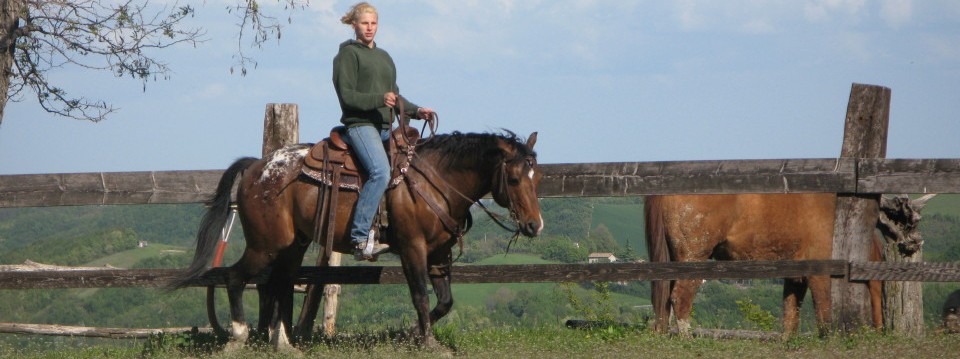
Noah durante un esercizio della terza lezione
“Dalla sedia alla sella” è un corso di una settimana in cui abbiamo concentrato più di venti anni di esperienza nel mettere insieme persone e cavalli: dieci lezioni per passare dalle due alle quattro zampe, comprese le basi di pronto soccorso (umano e veterinario) e l’orientamento. Si comincia con storia e teoria, si passa a tre/quattro ore al giorno in sella (più il tempo passato a gestire gli animali) e si finisce con la prima uscita in collina.
Come sempre si tratta di un corso individuale (una persona, un cavallo, un istruttore) e per questo accettiamo al massimo tre aspiranti cavalieri (ciascuno può però portare un accompagnatore: mamma, fidanzato, amico…). Il corso si terrà con qualsiasi tempo, purchè ci siano almeno due cavalieri partecipanti.
Obbiettivi del corso. Alla fine del corso si prevede che l’allievo sia in grado di uscire in sicurezza dalle strutture chiuse muovendosi in sella su ogni tipo di terreno, se accompagnato (NB: ogni capacità acquisita deve essere considerata come “provvisoria”: solo la pratica le renderà “stabili”: in nessun modo questo corso può sostituire la pratica necessaria né garantire l’incolumità di cavallo e cavaliere: per noi di Rancho Comancho, pur nel rispetto delle leggi, la responsabilità di quanto accade una volta in sella è sempre e solo del cavaliere se non in caso di mala gestio da parte di chi mette a disposizione animale e attrezzature).

La cura del cavallo è parte del corso
Si intende quindi che dal Primo maggio l’allievo sarà in grado di: gestire la preparazione del cavallo prima e dopo l’uscita (dalla sua presa in recinto alla sua messa al palo in sicurezza, dalla pulizia dei piedi, al controllo dei materiali, alla sellatura); di salire e scendere di sella in sicurezza; di eseguire le manovre base alle tre andature (stop, volte, mezze volte); di muoversi in sicurezza a pelo al passo; di recuperare le redini in movimento; di affrontare salite e discese fuori sentiero; di muoversi in sicurezza nei boschi; di muoversi in sicurezza insieme ad altri cavalli, in gruppo e indipendentemente. Sono incluse una lezione di primo soccorso umano (CPR), una di anatomia e primo soccorso equino e una di orientamento su carta e con GPS (tenute da esperti).

Pausa durante un Camp
Il corso prevede l’arrivo al Ranch il 24 Aprile in serata e i saluti la sera del Primo Maggio. I partecipanti saranno iscritti come soci al Club Rancho Comancho e ospitati nelle sue strutture.
Chiunque fosse davvero interessato può compilare questo modulo e riceverà al più presto le specifiche del programma. I posti sono solo tre, affrettatevi!


New year, new initiatives. We came up with a new proposal, for our friends as well as everyone else, for novice riders who are absolute beginners and for those with riding experience (of the “jump on the horse and I’ll take you on a trail ride” type ) and who have arrived at the conclusion that in order to be relaxed and confident on a trail ride you need more than a butt and a horse.
“From seat to saddle” is a week-long course where we have concentrated 20 years of experience on how to put people together with horses: ten lessons to go from two to four legs, with the basics of human first aid and veterinary first aid and orientation. It starts with history and theory, then progresses to three/four hours each day in the saddle, ending with going out on a trail ride around our hills.
Here’re some details of what the course is really about.
From seat to saddle, course for novice riders. (Fourteen years old and up).
Maximum participants: three riders plus maximum three partners (i.e. parents of young participants or non-riding partners of participants). The course will be held under all weather conditions, as long as there are at least two riders participating.
Goals of the course.
At the end of the course we expect that the rider will be able to leave the closed structures in safety and be able to move in any kind of terrain when he’s in the saddle, if he’s accompanied ( NB: each skill learned must be considered as “provisional”: only by practice will it become “stable”: in no way can this course substitute the practice required nor can it guarantee the safety of horse and rider: the responsibility of what happens when he’s in the saddle is always exclusively the rider’s, unless it’s a case of bad management on the part of who is responsible for horse and equipment).
So in other words this means that from the beginning of May the novice rider will be able to: manage the preparation of the horse before and after riding (starting from fetching the horse from the corral and tying him to the post, all done safely; from cleaning hooves to checking all equipment, to saddling the horse); mounting and dismounting safely, carrying out all basic maneuvers at all three gaits (stop, turns, half turns, diagonals); riding bareback safely at a walk; recuperating the reins when moving; affronting going uphill and downhill when on a trail ride; riding safely in the woods, riding safely with other horses, with other people and alone.
There will be a lesson on first aid for humans (CPR), a lesson on anatomy and first aid for horses and a lesson on orientation, both on a map and GPS, held by experts.
Arrive at the ranch on April 24th in the afternoon and leave the night of May 1st.
If you like to have a detailed program, just fill the form above.
Consigli utili (in inglese e latino) piante tossiche per i cavalli
This is useful and interesting: maybe somebody else could try to finish the list… Questo post è utile e interessante: contiene una prima lista di erbe dannose per i cavalli. E’ in inglese, ma ci sono i nomi latini e quindi è facile ricollegarli alla realtà italiana. Se qualcuno conosce altre piante dannose per i cavalli, per favore, invii un commento con i nomi: stiamo pensando a una piccolissima pubblicazione utile per tutti. Grazie


Gypsy, the Equine Encyclopedia, has something to say about plants that are toxic to horses. Like all shetlands, she is always watching, listening and learning.
Some plants that horses must not eat are:
Bracken Fern (Pteridium aquilinium)
Castor Bean (Ricinus communis)
Fiddleneck (Ansinckia intermedia)
Prince’s Plume (Stanleya spp.)
Horsetail (Equisetum spp.)
Japanese Yew (Taxus cuspidata)
Jimsonweed (Datura spp.)
Oleander (Nerium oleander)
Locoweed (Astragalus spp.)
Tansy Ragwort (Senecio jacobaea)
Rattleweed (Crotalaria spectabilis)
Wild Cherry (Prunus spp.)
Red Maple (Acer rubrum)
Woody Aster (Xylorrheza spp.)
Yellow Star Thistle (Centaurea solstitialis)
Wild Onion (Allium validum)
These are only a few plants; many more exist.
Thanks for having us informed… Questa notizia, a parte il discorso sulla scelta di mangiare cavallo o meno, è tosta per chiunque, perchè riguarda un ennesimo caso di problema nella catena alimentare umana. Pare infatti che in Gran bretagna e Irlanda siano stati serviti hamburger preparati usando carne di cavallo non in regola con le normative, in quanto “impestata” di fenilbutazone, che proprio bene non fa. Niente del genere è stato ancora rilevato in Italia, pare, ma vedremo di tenervi aggiornati.

Food Standard Agency’s acceptance about exporting the positive tested 5 horses to France for eating purposes, for a drug considered harmful for humans has caused massive uproar
The news about contaminated horse meat being sold for food in the EU first broke in a national debate when Mary Creagh, the shadow environment secretary of UK, brought to the notice of the house that action is necessary to be taken against the entry of contaminated horsemeat into the human food chain.
 Ms Creagh argued that injections, Phenylbutazone called bute for short, given to horses which had later been taken to the abattoir for meat. Traces of this contaminated meat had been found in burgers being sold by some restaurants in UK and Ireland. The restaurants later issued public apologies for selling these burgers.
Ms Creagh’s claims based on the report filed by the Food Standards Agency or FSA that it had found eight horses which got detected administered…
View original post 240 altre parole
Factual, precise, useful: thanks from our people too. Questo articolo in inglese è preciso, didascalico e utile. Sul sito ci sono altre cose interessanti, vedremo di tenerlo d’occhio.
 Rancho Comancho